


V-Funnel Apparatus
Self-Compacting Concrete (SCC) Workability Testing
General Information
| Equipment Name | V-Funnel Apparatus |
| Full Form | V-Funnel Apparatus for SCC Testing |
| Application | Self-Compacting Concrete (SCC) Workability Measurement - Flow time and viscosity assessment |
| Test Method | Measurement of concrete flow time through V-shaped funnel apparatus |
| Standards Compliance | EFNARC Guidelines; IS (Indian Standards); EN Standards (European Norms) |
Equipment Description
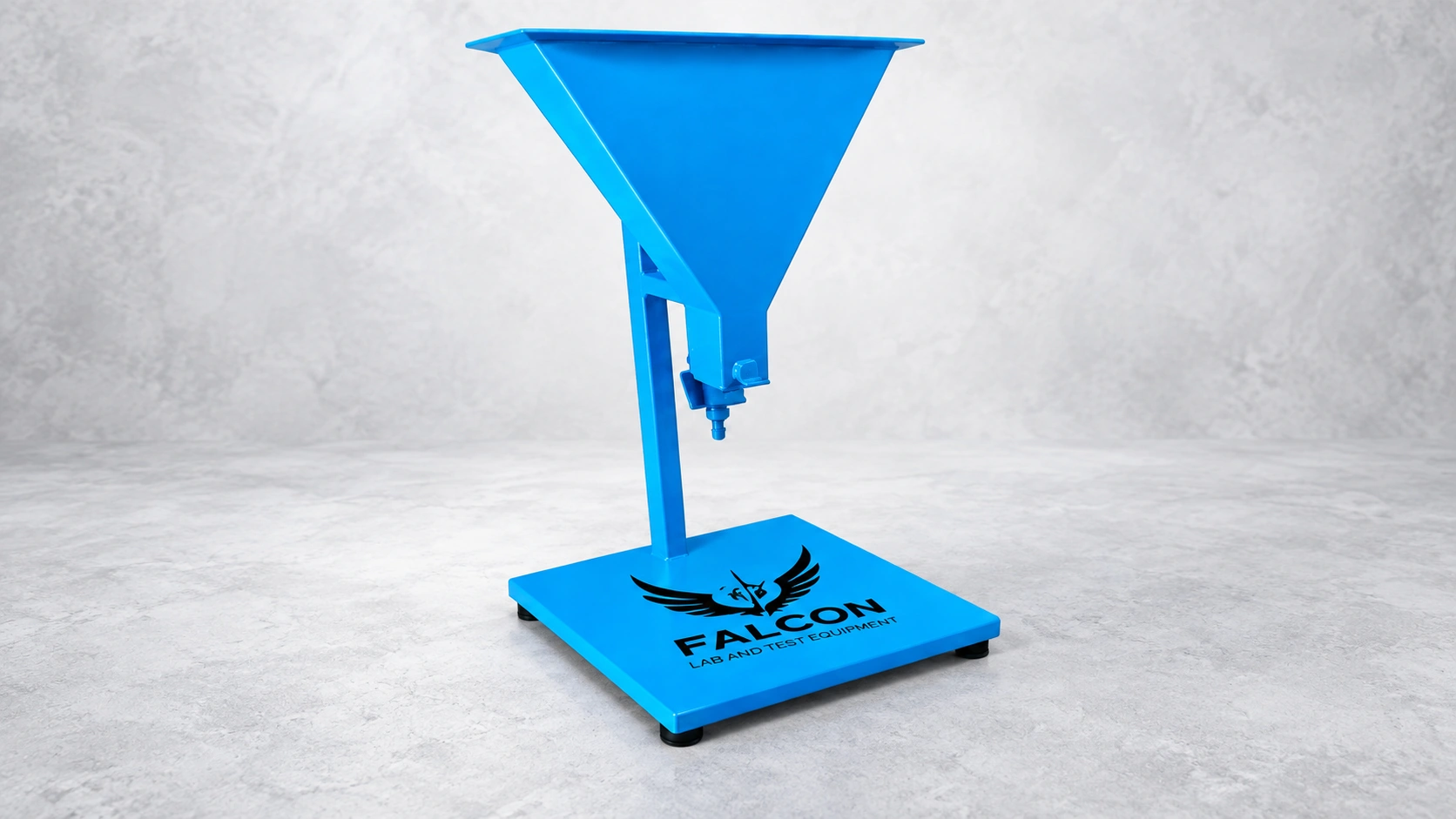
The V-Funnel Apparatus is a specialized testing device designed to evaluate the workability and flow characteristics of Self-Compacting Concrete (SCC). It measures the time taken for fresh concrete to flow through a V-shaped funnel under gravity, providing critical data on the concrete's viscosity, flow ability, and passing ability. The apparatus features a quick-release trap door mechanism for controlled discharge and is constructed to ensure leak-proof operation during testing.
Main Component
V-Funnel Body Assembly
- Stainless Steel (SS 304 Grade) construction
- V-shaped internal geometry for smooth, unimpeded concrete flow
- Smooth internal surface to prevent aggregate bridging
- Rigid welded construction to prevent deformation
- Top inlet opening: 515 mm × 515 mm (square)
- Bottom outlet: 65 mm × 75 mm (rectangular)
Discharge Mechanism
- Quick-release trap door at bottom outlet
- Leak-proof sealing system
- Controlled discharge for accurate testing
Support Frame
- Heavy-duty laboratory-grade GI sheet outer frame
- Reinforced frame for maximum stability
- Corrosion-resistant powder-coated finish
- Rigid metallic construction base
Technical Specifications
| Parameter | Specification |
|---|---|
| Top Inlet Opening | 515 mm × 515 mm (Square) |
| Funnel Height | 600 mm |
| Bottom Outlet Size | 65 mm × 75 mm (Rectangular) |
| Wall Thickness | Heavy-duty laboratory grade |
| Material | Stainless Steel (SS 304 Grade) + GI Sheet |
| Design | V-shaped funnel with smooth internal surface |
| Discharge Mechanism | Quick-release trap door (leak-proof) |
Construction Details
- Body Material: Stainless Steel (SS 304 Grade) with smooth internal surface to ensure uniform flow
- Outer Frame: Heavy-duty laboratory-grade GI sheet with reinforced design for structural stability
- Construction Method: Rigid welded construction to prevent deformation during operation
- Surface Finish: Smooth machined internal surfaces; corrosion-resistant, powder-coated exterior
Operating Principle
- Fresh concrete is poured into the top inlet opening (515 mm × 515 mm)
- The trap door at the bottom is released simultaneously with concrete pouring
- Concrete flows through the V-shaped funnel under gravity alone
- Flow time is measured from release until concrete stops flowing from the outlet
- The measured time indicates viscosity and flow characteristics of the SCC
Performance Requirements
| Performance Aspect | Requirement |
|---|---|
| Flow Characteristics | Smooth, uninterrupted flow without blockage |
| Sealing Integrity | No leakage during filling and discharge cycles |
| Test Repeatability | Repeatable and accurate test results within tolerance |
| Structural Stability | Remains rigid during testing without deformation |
| Operating Durability | Suitable for continuous laboratory use |
Safety Features
- Stable, reinforced base stand to prevent tipping
- Secure clamping and support mechanisms for safe operation
- Smooth surfaces and rounded edges to prevent injury
- Non-slip contact surfaces for stability during concrete discharge
- Easy-to-use quick-release mechanism with clear operational guidelines
Application Areas
- Civil Engineering Testing Laboratories
- Concrete Quality Control and Assurance Laboratories
- Ready-Mix Concrete Plants and Production Facilities
- Research and Development (R&D) Concrete Mix Design Studies
- Construction Material Testing Facilities
- Academic Research Institutions and Universities
- Precast and Prefabricated Concrete Manufacturing Plants
Maintenance & Care
- Clean thoroughly after each test to prevent concrete buildup
- Regularly inspect for wear, damage, or deformations affecting accuracy
- Check sealing gaskets and trap door mechanism for proper functioning
- Maintain smooth internal surfaces to ensure unimpeded concrete flow
- Perform periodic calibration to verify test accuracy